


 English
 русский
 中文简体
 عربى

A full order is a commitment. A sample is the cheap way to find out whether that commitment makes sense. The trouble is that many sample tests never really test anything. The strips go through the tool once, a carton closes, everyone nods, and the pallet order goes out on hope.
A better version takes a week and answers three questions only. Does the copper stapler pin feed without babysitting? Does it clinch cleanly through the board you actually buy? And does it keep behaving once the warehouse stops being kind to it? Everything that follows is one way to get those answers without a laboratory.
What Should a Sample Test Prove Before Anything Else?
Three things. Not five, not ten. Every extra check you add makes the test longer and the result harder to read.
Will it feed without babysitting?
Feeding is the quiet part of fastening. A strip that sits slightly wrong in the magazine will still fire for a while, then skip, then double-feed, and the operator spends the afternoon tapping the tool. A sample either travels through the machine smoothly or it does not. One hour tells you enough.
Will it clinch through your own board?
Showroom board is polite. Production board is not. Flute crush, moisture, a liner that varies between deliveries: all of it sits between the crown and a clean closure. Test on cartons from the current run, not on the neat sample the box supplier keeps behind the desk.
Will it keep behaving on a bad day?
Nobody orders fasteners for a calm Tuesday in April. They order them for a humid week in July when the dock door stays open and the board feels soft. A sample that only works in dry air has not been tested yet, it has been introduced.
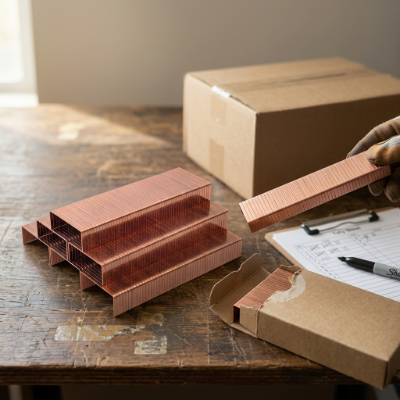
Day One: Inspect the Box the Way a Receiver Would
Before a single strip goes near a tool, look at what arrived. This is the stage people rush, and it is the stage that explains half of the problems that show up later.
| What to look at | What a problem looks like | Why it matters later |
|---|---|---|
| Strip or coil integrity | Loose staples, gaps in the collation, a coil that springs apart | Feeding trouble that looks like a machine fault |
| Shape of the crown | Bent bridges, uneven legs, staples sitting at an angle | Poor clinch and a seam that looks careless |
| Surface finish | Patchy coating, scratches down to bare wire, dark spots | Appearance on kraft cartons, and storage life on a damp dock |
| Box and inner packing | Crushed corners, staples loose in the carton, no moisture barrier | Damage that happened in transit, not in production |
| Label and batch mark | Batch number missing or unreadable | No way to trace a problem back to a production run |
Take photos of everything you note. If the trial ends with a mixed result, those photos are the difference between a clear conversation and a vague one.
Day Two: Fit It to the Machine, Not the Other Way Around
Load a short length of the sample into the tool yourself, slowly. Notice whether it drops in or has to be pushed. Notice whether it seats flat or rides high at one end. A strip that needs persuasion on day two will need a hammer by week six.
Then check the obvious settings before blaming the product. Air pressure at the level the line normally runs. Magazine clean. Driver blade free of burrs. Nose and clincher in the position the manual describes. Half of the complaints that reach a fastener supplier are resolved in this ten-minute check.
One more thing worth writing down: the exact tool model and the format it accepts. When the trial finishes and you compare two suppliers, that line on the sheet prevents an expensive misunderstanding.
Day Three: Run the Board You Actually Buy
Set aside a dozen cartons from the current production batch. Close them the way the line closes them, at the pace the line runs. Not slower to be careful. Slower is a different test.
Then turn each carton over and look at the clinch. What you want is unglamorous: legs bent neatly against the inner liner, both of them, the same on every carton. What you do not want is splayed legs, a leg that punched through, or a crown sitting on flattened flutes with the board dented underneath.
Ten cartons in, you should already be able to say whether the copper stapler pin suits this board. If the answer is close, keep going. If it is clearly no, stop and change one variable at a time. Changing crown width and leg length together will teach you nothing except that something is wrong.
Ask the operator what they noticed, too. Hands feel things that a photo cannot show: a tool that kicks back a little harder, a strip that needs a nudge at the start of the magazine, a closure that sounds different on the second carton. Those small impressions often point at the cause a week before the numbers do.
Day Four: Count the Interruptions Instead of Describing Them
Memory is generous to a new supplier. Counters are not. Keep a simple tally for a full shift: cartons closed, jams, misfeeds, staples that had to be pulled out by hand.
Two numbers matter. How often the tool stopped, and what the operator did to restart it. A jam cleared by opening the magazine and closing it again points at the strip. A jam cleared by adjusting the nose points at the tool. Same interruption, different culprit.
Note the batch too. If the trouble starts with a second box from a different production run, you have learned something about consistency that no datasheet will tell you.
Day Five: Pull a Seam Apart on Purpose
You are not running a certification test here, and you do not need one. You need a comparison you can trust with your own hands.
- Close five cartons with the copper stapler pin sample and five with the fastener you use today.
- Hold each one the same way and pull the flap back with steady force until something gives.
- Watch where it fails. Board tearing around the crown tells a different story from legs straightening out.
- Drop one carton from shoulder height onto a hard floor, landing on a corner, then inspect the seam.
- Stack a few overnight with weight on them, then look for crushing along the closure line.
Nothing here is scientific. It is still more honest than a gut feeling, because both products went through the same abuse on the same afternoon.
Day Six: Give It a Bad Day
Leave an open box of the sample in the warehouse overnight, away from the sealed packaging. Run it the next morning without any special treatment. If your site has a humid season, this single step predicts more about real performance than a week of dry-weather trials.
Look for two things. Whether the strips still separate cleanly from each other, and whether the surface has changed. A little darkening on the wire is normal and usually harmless. What you are watching for is anything that changes how the material feeds.
Do the same with a carton that has spent the night in the same air. Soft board behaves differently, and that is exactly the condition your fasteners will meet in the field.
Day Seven: Write One Page and Make a Call
One page. Not a report, a page. Board type, tool model, cartons closed, interruptions counted, what the clinch looked like, what the pull test showed, and a photo of the seam.
Then pick one of three verdicts. Approve as it stands. Approve with a note, meaning the product works but one detail needs agreeing before the order, such as packing or finish. Or reject with a reason specific enough for the supplier to act on. A rejection that says the quality was not good teaches nobody anything. A rejection that says the strips rode high in the magazine after two hours tells the factory exactly where to look.
What Do You Do With the Sample After the Trial?
Keep it. Seal the remainder in a bag, write the date and the batch on it, and put it somewhere the production team can find it without asking around. That box becomes the reference point for every future delivery, and it is the physical evidence you reach for when a new batch behaves slightly differently from the one you approved.
Send a photo of the approved seam to the supplier as well. Two pictures, one of the crown from above and one of the clinch from underneath, say more about what you expect than a paragraph of description. When a repeat order arrives months later, that pair of images settles the question of whether the product changed or the board did.
What Goes Wrong in Sample Tests More Often Than It Should
- Testing with the tool nobody uses, because it happened to be free that morning.
- Using clean cartons from stock instead of the ones the line is actually running.
- Running for ten minutes and calling it a shift.
- Accepting a sample that arrives without a batch mark, then having no way to trace it later.
- Judging by the crown alone and ignoring how the strip feeds.
- Skipping the damp-air step because the trial happened in a dry month.
- Comparing two products on different days, in different conditions, with different operators.
Questions That Come Up in the Middle of a Test
How many cartons are enough?
Enough to see a pattern, not enough to prove a theory. A few dozen across one shift, on board from the current batch, usually settles it. If the result is mixed after that, the problem is patience rather than sample size.
Should the supplier be told it is a trial?
Yes, and it works in your favour. A supplier who knows the sample is being compared tends to send the batch they would ship, and can answer questions about format and finish while the test is still running.
What if the sample performs well but the full order does not?
That is a specification problem, not a mystery. Keep the approved sample, photograph the seam, and record the batch. A physical reference removes a good part of the argument later.
Is it worth testing more than one supplier at a time?
Worth it, if both run on the same board in the same week with the same operator. Otherwise you are comparing weather.
The Week Is the Point
Seven days sounds like a delay. In practice it is a week spent avoiding a season of small irritations: a strip that will not sit flat, a seam that opens on the third pallet, a batch nobody can trace.
A copper stapler pin is a small purchase next to the cartons it closes. That is exactly why it deserves a proper trial rather than a hopeful nod. Run the week, keep the notes, compare the seam against the carton closing staples you trust today, and let the result make the decision for you.

 Quick Links

