


 English
 русский
 中文简体
中文简体 عربى
عربى
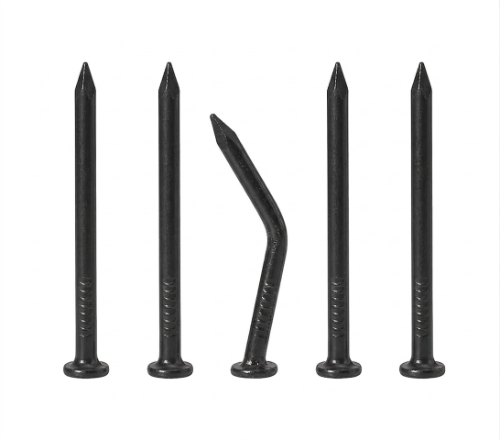
Anyone who has spent an afternoon nailing furring strips or trim onto a concrete wall has probably run into at least one bent nail. It happens quietly at first, a slight wobble in the shank, then a full bend halfway through the strike, and suddenly the nail is useless.
Bending is not really random, though it can feel that way in the moment. It usually comes down to a combination of the concrete surface, the nail itself, and how the hammer strikes it. Understanding these factors makes it easier to spot the cause and avoid repeating it on the next nail.
Why Does Concrete Push Back So Hard?
Concrete is not a soft, forgiving material like wood or drywall. It resists penetration, and that resistance is exactly what a nail has to work against.
Density Determines How Much Force Is Needed
Denser concrete, especially older slabs that have fully cured, offers more resistance to a driven nail. A nail that goes into fresh block with little effort might need several more solid strikes on a hardened slab, and every extra strike is another chance for the nail to shift off its straight path.
Hidden Aggregate Can Deflect a Nail Mid Strike
Concrete contains aggregate, and larger pieces of stone or gravel sit just below the surface in a somewhat random pattern. If the tip of a nail happens to meet a piece of aggregate instead of the softer cement paste around it, the nail can deflect sideways rather than continuing straight down. Once that happens, a bend is often just one more hammer strike away.
How Does Hammer Technique Contribute to Bending?
The tool doing the striking matters just as much as the surface receiving it.
Angle Matters More Than Force
A hammer that strikes at even a slight angle pushes the nail sideways instead of straight down. Over several strikes, that sideways pressure adds up, and the shank starts to curve. Most bent nails trace back to this one issue more than anything else.
Inconsistent Strikes Create Weak Points
A series of light, hesitant taps followed by one heavy strike puts uneven stress on the nail. Steady, even strikes tend to keep the nail traveling in one consistent direction, while a mix of soft and hard hits gives the nail more opportunities to wander off course.
Hammer Weight Needs to Match the Job
A lightweight hammer swung repeatedly to compensate for insufficient force often does more harm than good. Each light strike barely moves the nail forward, yet still applies lateral stress on the shank. A hammer with enough weight for the surface tends to drive the nail in fewer, cleaner strikes.
Does Nail Quality Affect Bending?
Not every concrete nail is built the same way, and the differences show up most clearly under stress.
| Nail Factor | Effect on Bending Risk |
| Shank Hardness | A softer shank flexes more easily under resistance |
| Shank Diameter | Thinner shanks bend more readily than thicker ones |
| Shank Straightness | A nail that starts slightly bent tends to bend further under force |
| Surface Coating | Coating affects corrosion resistance more than bending resistance |
| Point Sharpness | A dull point struggles to break into dense concrete cleanly |
This is one reason buyers sourcing concrete nails in bulk often ask suppliers about shank consistency, since a batch with uneven hardness can behave unpredictably even when the installation technique stays the same.
What Role Does Nail Length and Diameter Play?
Choosing the wrong size for the job can set a nail up to bend before the hammer even makes contact.
Nails That Are Too Long for the Surface
A nail longer than necessary for the material being fastened has to travel further through resistant concrete, giving it more distance and more opportunities to deflect off course.
Nails That Are Too Thin for the Task
A thinner nail flexes more easily under lateral pressure. For denser concrete or thicker materials, a slightly heavier gauge nail tends to hold its line better than a thin one pushed past its practical limit.
Can Hidden Obstructions Cause Bending?
Sometimes the issue has nothing to do with technique or nail quality at all.
- Rebar or wire mesh sitting close to the surface can stop a nail cold or deflect it sideways
- Air pockets within the concrete can cause uneven resistance as the nail travels through
- Old patches or repaired sections of a slab may have different density than the surrounding concrete
- Surface cracks near the nailing point can shift under pressure and throw the nail off angle
In these situations, moving the nailing point a short distance often solves the problem faster than trying to force through the same spot repeatedly.
How Can Bending Be Reduced in Practice?
A few adjustments to setup and technique tend to reduce bent nails noticeably.
- Start the nail with light taps to set it straight before applying full force.
- Keep the hammer square to the nail head rather than striking at an angle.
- Match hammer weight to surface hardness instead of relying on repeated light strikes.
- Choose a nail length and diameter suited to the material rather than defaulting to whatever is on hand.
- Reposition slightly if the first strikes meet unusual resistance, since that often signals aggregate or reinforcement below the surface.
Manual Hammering Versus Powered Tools
For buyers and contractors working across many units, tool choice can influence bending rates almost as much as the nail itself.
| Method | Typical Bending Risk |
| Manual Hammer, Experienced Technique | Generally low with consistent, square strikes |
| Manual Hammer, Inconsistent Technique | Higher, especially on dense or uneven surfaces |
| Powered Nail Gun or Hammer Drill Assist | Generally lower due to consistent force and angle |
Powered tools do not eliminate bending entirely, but they tend to remove some of the variability that comes from manual strikes, particularly on harder or less predictable concrete.
What Should Buyers Ask Before Choosing Concrete Nails?
For businesses purchasing concrete nails regularly, a few practical questions can help reduce bending issues before they start on site.
- Does the supplier maintain consistent shank hardness across production batches?
- Are different lengths and diameters available for different surface types?
- Can the supplier explain how their nails typically perform on denser concrete?
- Is packaging organized in a way that keeps nails straight during storage and transport?
Bent nails are usually a signal rather than just bad luck. Whether the cause traces back to hammer angle, surface density, hidden aggregate, or a mismatch between nail size and material, there is almost always a specific reason behind it. Paying attention to these details tends to reduce wasted nails and wasted time far more effectively than simply hammering harder and hoping for a better result next time.

 Quick Links
